This is a place created to share the information, interests, opinions, and ideas of dancing. We believe that dancing is part of humans' life where emotion is expressed through the movement of body. Dance is created for humans and, hence, we also believe that everyone can actually dance and enjoy dancing. Find out more about dance here. If you can't find any reason to dance, just dance with me!
Are you wondering what kind of dance style can bring and stretch the human body to its limits?
Breakdancing is originated from the dance "Good Foot," which was performed by James Brown. However, the B-Boy and the Breakdancing followed by the dance moves of James Brown are very different nowadays as it is constantly increasing in popularity in the young generation. Breakdancing is considered very well-suited for competition, and it is known for its almost acrobatic dance style. As a result of that, the dance style attracted many athletic teenagers in the U.S., which later significantly evolved and developed the dance in the streets.
Now let me show you the difference between modern breakdancing and James Brown's dance moves. This is a video clip of James Brown's best dance break-it-down moments! I'd say he deserves to be in the list of one of the legends of dance.
Here, I have another video of some power breakdance moves in today's breakdancing.
As you can see, there is a big difference between the two. The breakdancing moves seen in the second video is originated from James Brown's "Get on the Good Foot." The provocative and intimidating element of the modern breakdance is started from South Bronx, where it is especially popular for street gangs and youth.
Breakdancing is a form of competition and not only it helps to create a healthier lifestyle by increasing your physical and mental fitness, it is a unique way to express yourself!
Now, extend your body and take your body to its limits!
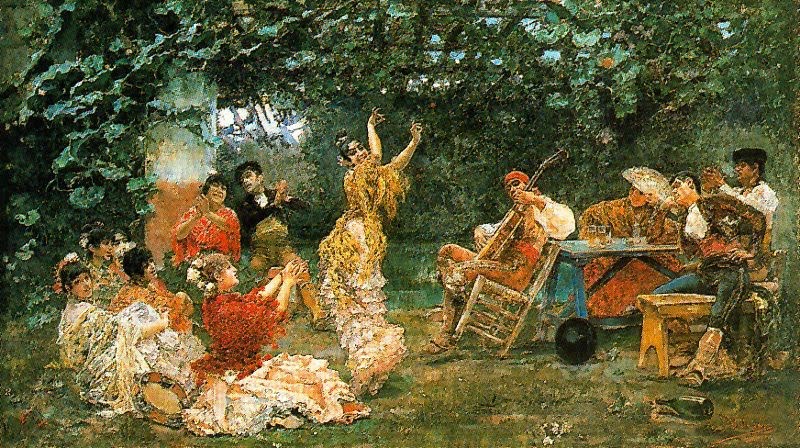
Flamenco is a genre of south Spanish dance combining with guitar playing, singing, finger snapping, hands clapping, and dance. The first mention of flamenco on literature is 1774, it is record as the genre of Andalusian music and dance styles. Flamenco has become popular and developed in many countries in recent years, such as united state and Japan.For japan's development of flamenco, there are even more academic theory than the dance in Spain. On November 16, 2010 UNESCO declared flamenco one of the Masterpieces of the Oral and Intangible Heritage of Humanity.
The word “flamenco" in Spanish has the meaning of fire and flame, that might be hints the music style and dance style is full of passionate and strong feeling of rhythm , as this video shows :
As the video shows, the rhythm is slow and relaxing at the beginning of the music , as the rhythm became faster, the dance is going faster as the rhythm change.
"Palos" is the word that refer to the dance style of flamenco. Palos are classified as many criteria, for example,mode, chord progression, or rhythm pattern. there are more then 50 different types of palos and some of those are hard to performed.
There are some most know and popular Palos:
Alegrías
Bulerías
Bulerías por Soleá
Cartageneras
Fandango
Fandango de Huelva
Fandango Malageño
Granaínas
Malagueñas
Mineras
Rondeñas
Rumba
Saeta
Seguiriyas
Sevillanas
Soleá por Bulerías
Tangos
Tanguillos
Tientos
Villancicos
The forms of flamenco perform is :Toque( guitar),Cante (song),and Baile (dance), therefore, "flamenco" is a word as performing style, including music and dance.
Dance in Indonesia reflects the country's diversity of ethnicities and cultures. There are more than 700 ethnic groups in Indonesia: Austronesian roots and Melanesiantribal forms are visible, and influences ranging from neighbouring Asian and even western styles through colonisation. Each ethnic group has their own dances; makes total dances in Indonesia are more than 3,000 Indonesian original dances. The old traditions of dance and drama are being preserved in the many dance schools which flourish not only in the courts but also in the modern, government-run or supervised art academies.
Traditional dance of Indonesia reflect the rich diversity of Indonesian people. The dance traditions in Indonesia; such as Balinese, Javanese, Sundanese, Minangkabau, Palembang, Malay, Aceh and many other dances traditions are age old traditions, yet also a living and dynamic traditions. Certain traditional dances might be centuries old, while some others might just created less than a decade ago. The creation of a new dance choreography but still within the frame of respected dance tradition and discipline is still possible. As the result, there is some kreasi baru (newly created) dances. The newly created dance could be the rediscovery and the revival of lost old traditions or a new interpretation, inspiration and exploration of traditional dances.
There are some popular dance dramas of Java and Bali feature episodes from the Hindu epics, Ramayana and Mahabharata. these are:
· Kecak (pronounced KEH-chahk) is a Balinese music drama which originated in the 1930s. Also known as the Ramayana Monkey Chant, it depicts a battle from the Ramayana where monkeys help Prince Rama fight the evil King Ravana. It is performed by 100 or more men wearing checked cloth around their waists, seated in a circle, swaying to the rhythmic echoes of their own voices, chanting "cak" and throwing up their arms ... a sight to behold!
· Legong (pronounced LAY-gong) is a graceful Balinese dance performed usually by young girls dressed in gold brocade wrapped tightly around their bodies and headresses decorated with flowers.In the dance, accompanied by gamelan ensemble, two beautiful dancers move their bodies, hands, fingers, heads and eyes with supple grace and in perfect unison with each other. Seeing is believing.
· Barong (pronounced BAH-rong) is a dance that epitomizes the eternal struggle between good and evil. The barong is a mythological animal, often represented by a lion (barong ket). He is a protector spirit and enemy of Rangda, the demon queen.The barong costume resembles a lion with long mane, small head, bulging eyes and sharp fangs.
It is manoeuvred by two men, one in front of the other. The barong has mischievous but controlled movements - snapping its jaws now and then.
· Jatilan or kuda kepang is a trance dance involving eight or more male dancers with weaved bamboo hobby horses. The dancers move as if they are riding a horse during war and may carry holstered weapons. They wear knee-length pants and bangles on both legs. The dance is accompanied by music and sometimes masked comedians. The dancers would begin in an orderly fashion, trotting around but the dance would not be deemed complete till some dancers are posssessed by the spirit of the horse and start behaving wildly.